

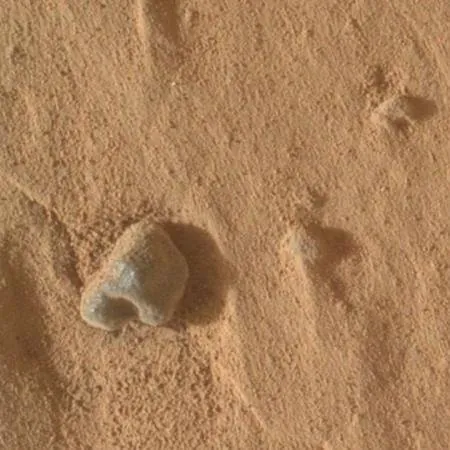
The scientific world is witnessing one of the most exciting discoveries of recent years. The expected answer has finally come about the mysterious meteorite, which was found by chance among the endless sands of the Sahara Desert in 2022 and weighs approximately 1 kilogram. As a result of comprehensive geological and chemical analyses, it has been definitively proven that the origin of this ancient piece is the planet Mars. This discovery means not only the discovery of a piece of stone, but also the opening of a huge door into the past of our neighboring planet billions of years ago.
Background of the Incident
The discovery in question was actually unearthed during a field study carried out in the Sahara Desert two years ago. This meteorite, dating back to approximately 4.1 billion years ago, was studied with great curiosity by scientists when it was first found. The fact that the age of the stone was so close to the formation stages of the solar system turned it from an ordinary meteorite into a time capsule that kept the history of the universe. Long-term laboratory studies revealed that the mineral arrangements and isotopic signatures in the internal structure of the stone exactly match the geological structure of Mars.
The scientific value of this finding is that it provides invaluable data about the atmospheric and geological state of Mars billions of years ago. The fact that a meteorite broke off from Mars and reached Earth is evidence of the massive collisions and geological activity on that planet. This age of 4.1 billion years strengthens the theory that Mars may have once had a very different structure, perhaps more suitable for hosting life. Scientists predict that this small but valuable piece will add a new dimension to the discussions about the presence of water and mineral diversity on Mars.
What to Expect Next? Following this discovery, space agencies are expected to gain new momentum in their Mars-focused research. Especially for teams working on missions to return samples directly from Mars, such natural samples are worth their weight in laboratory simulations. In the future, by examining the microscopic remains inside this meteorite, much more concrete evidence may be obtained as to whether life once existed on Mars. Humanity's search for life on other planets will be moved to a much deeper and scientific dimension with the guidance of this small piece of rock.








COMMENTS (0)
Community CommentsNo comments yet. Be the first to share your thoughts on this story!