

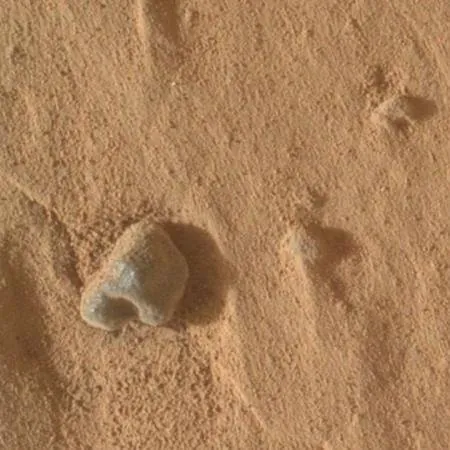
The scientific world is witnessing one of the most exciting discoveries in recent years. The long-awaited answer finally came regarding the mysterious meteorite that was found by chance among the endless sands of the Sahara in 2022 and weighs about 1 kilogram. As a result of comprehensive geological and chemical analyses, it has been conclusively proven that the origin of this ancient object is Mars. This discovery means not only the discovery of a piece of stone, but also the opening of a huge door into the past of our neighboring planet, billions of years ago.
Background of the accident
The discovery in question was actually made during a field study conducted in the Sahara desert two years ago. This meteorite, which dates back approximately 4.1 billion years, was studied with great curiosity by scientists when it was first found. The fact that the age of the stone was very close to the stages of formation of the solar system transformed it from an ordinary meteorite into a time capsule that preserves the history of the universe. Long-term laboratory studies revealed that the mineralogical arrangements and isotopic signatures in the stone's internal structure exactly match the geological structure of Mars.
The scientific value of this discovery lies in that it provides invaluable data about the atmospheric and geological condition of Mars billions of years ago. The fact that a meteorite broke off from Mars and reached Earth is evidence of massive impacts and geological activity on that planet. This 4.1 billion year age reinforces the theory that Mars may have had a completely different structure, perhaps more suitable for hosting life. Scientists expect that this small but valuable piece will add a new dimension to discussions about the presence of water diversity and minerals on Mars.
What to expect next? After this discovery, space agencies are expected to gain new momentum in their research focusing on Mars. Especially for teams working on missions to return samples directly from Mars, such natural samples are worth weighing in laboratory simulations. In the future, by examining the microscopic remains inside this meteorite, clearer evidence could be obtained about whether life once existed on Mars. Humanity's search for life on other planets will move into a much deeper scientific dimension under the guidance of this small piece of rock.






COMMENTS (0)
Community CommentsNo comments yet. Be the first to share your thoughts on this story!